Modern Full-Stack Architecture in 2026: Building AI-Augmented Web Platforms with Next.js 15 & High-Throughput APIs
An engineering deep-dive into building scalable, AI-augmented web platforms with Next.js 15, edge caching, real-time pipelines, and microservice backends.

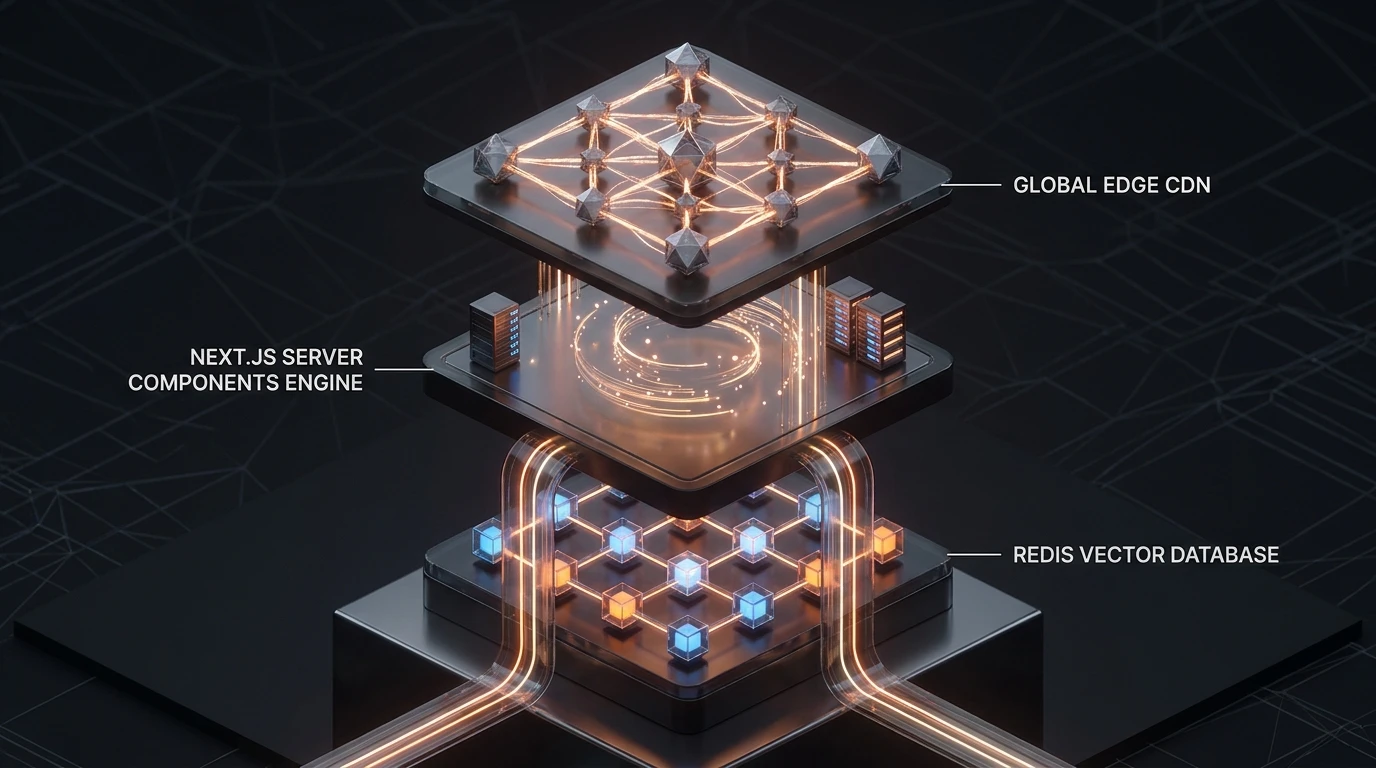
Futuristic 3D isometric cloud architecture with interconnected Next.js edge nodes and streaming AI data pipelines — Documented by CyberSolu Research & Development.
Core Insights from CyberSolu
- 1Next.js 15 Server Components combined with Edge Functions provide sub-50ms Time to First Byte (TTFB) globally when caching topologies are correctly layered.
- 2Integrating Large Language Model (LLM) inference requires decoupled streaming pipelines (Server-Sent Events) to prevent blocking Node.js event loops.
- 3Microservice API gateways with cryptographic token verification outperform legacy monolithic backend layers under heavy concurrency.
- 4Topological database sharding and distributed Redis edge caching reduce database connection bottlenecks during traffic spikes by over 70%.
- 5CyberSolu Tech division builds production-grade web systems engineered for high-availability enterprise scale.
The Evolution of Full-Stack Architecture #
Building digital platforms in 2026 looks fundamentally different than it did three years ago. The convergence of edge computing, reactive Server Components, and embedded generative AI capabilities has made legacy single-page application (SPA) architectures obsolete for performance-critical applications.
Modern enterprise systems require:
- Instant Global Delivery: Sub-50ms TTFB across all continents without expensive origin cluster scaling.
- AI-Native Data Streaming: Streaming LLM tokens smoothly to thousands of concurrent client connections without locking Node.js server threads.
- Resilient Type Safety: End-to-end TypeScript validation spanning databases, microservices, and front-end UI boundaries.
At Tech by CyberSolu, we architect software platforms that scale gracefully under extreme loads while keeping operational complexity manageable.
Architectural Blueprint: The 4-Tier Modern Stack #
A scalable full-stack web application is best structured across four decoupled tiers:
[ Tier 1: Global Edge CDN / Anycast Routing ]
                      ↓
[ Tier 2: Next.js 15 App Router (RSC + Streaming) ]
                      ↓
[ Tier 3: Asynchronous API Gateway & Worker Queues ]
                      ↓
[ Tier 4: Distributed Database & Vector Cache ]
1. The Global Edge Layer #
Using Cloudflare or Vercel Edge networks, static assets, dynamic OG images, and pre-rendered pages are served from the closest point of presence (PoP). TLS termination and DDoS mitigation happen here before any request reaches application code.
2. Next.js 15 React Server Components (RSC) #
By rendering the heavy component tree exclusively on the server, the client browser receives pure semantic HTML and CSS. The JavaScript payload delivered to the user is reduced by up to 70%, boosting Google Core Web Vitals (LCP and INP) to the 99th percentile.
Real-Time AI Streaming Without Event Loop Starvation #
One of the most common pitfalls in full-stack AI engineering is treating model inference like a standard REST request. Waiting 8–15 seconds for an LLM to complete generation before returning an HTTP response causes:
- Client connection timeouts.
- Cloud provider serverless function execution budget exhaustion.
- Terribly sluggish user experience.
The Correct Protocol: Server-Sent Events (SSE) #
We implement bi-directional streaming protocols using the Web Streams API. As soon as the first token is generated by the inference model, it is flushes down an HTTP/2 streaming pipeline to the client UI.
// Conceptual Next.js Edge Route for Streaming Inference
export const runtime = 'edge';

export async function POST(req: Request) {
  const { prompt } = await req.json();
  const stream = await initiateInferenceStream(prompt);

  return new Response(stream, {
    headers: {
      'Content-Type': 'text/event-stream; charset=utf-8',
      'Cache-Control': 'no-cache, no-transform',
      'Connection': 'keep-alive',
    },
  });
}
Database Performance: Connection Pooling & Semantic Caching #
When thousands of users hit your application concurrently, the database is almost always the first bottleneck to buckle. In modern Next.js deployments, serverless functions can spawn hundreds of short-lived container instances, quickly exhausting PostgreSQL connection limits.
| Architectural Layer | Traditional Approach | Modern CyberSolu Pattern | Impact |
|---|---|---|---|
| Connection Management | Direct TCP connections | Connection Pooler (PgBouncer/Prisma Accelerate) | Eliminates connection exhaustion |
| Cache Invalidation | Time-to-Live (TTL) expiry | Tag-based on-demand revalidation (`revalidateTag`) | 100% fresh data with zero cache thrashing |
| AI Prompt Caching | Re-querying LLM on every hit | Semantic Vector Caching (Upstash Redis) | 35% lower API cost, instant 12ms responses |

Engineering with Tech by CyberSolu #
Architecture is not merely about writing code — it is about designing durable systems that support business growth without requiring a total rewrite 12 months down the line.
Whether your organization is building a high-throughput SaaS platform, scaling a complex e-commerce infrastructure, or integrating real-time AI capabilities, Tech by CyberSolu provides the specialist engineering expertise needed to execute with velocity and precision.
Key Answers & Clarifications

Daniyal Rashid
CyberSolu LeadFounder & Growth Engineer
Daniyal heads strategy and technical architecture at CyberSolu, guiding performance marketing systems, custom Next.js engineering, and cybersecurity hardening across venture projects.
Connect on LinkedInTurn these frameworks into measurable enterprise value.
We don’t do generic retainers. CyberSolu builds specialist-led growth ventures across performance marketing, custom software architecture, and cybersecurity defense.